Stay Updated
Get the latest insights on emerging technologies, career opportunities, and SHEA updates delivered straight to your inbox.
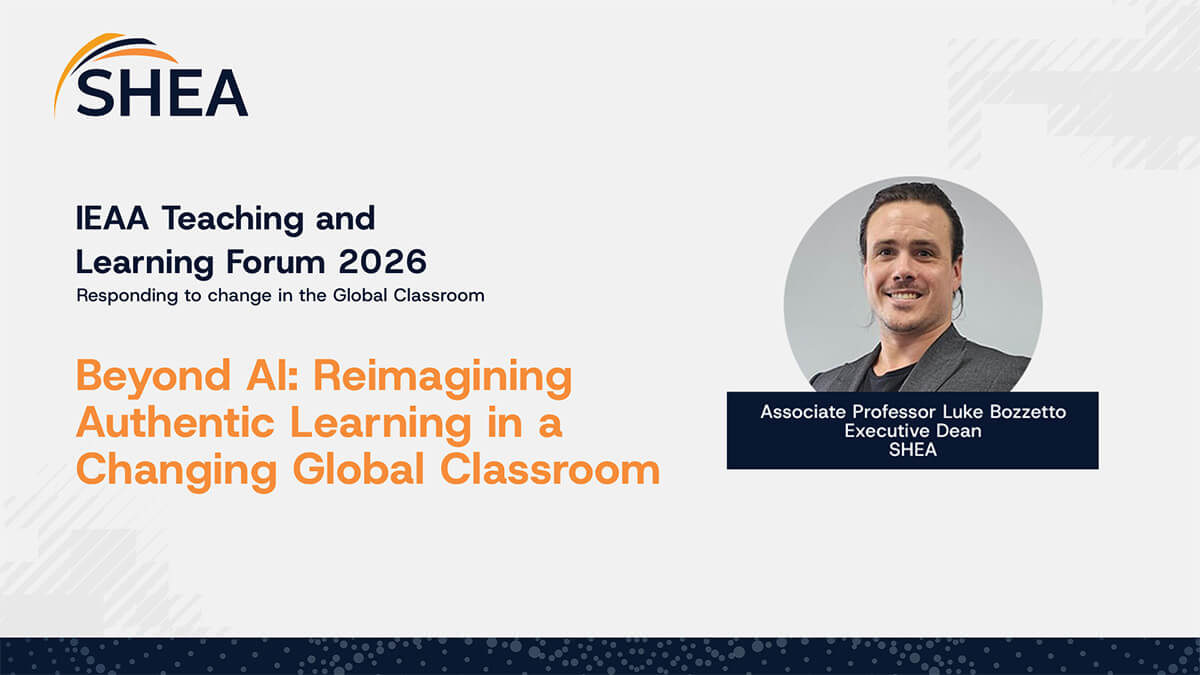
It was a pleasure to represent Skyline Higher Education Australia (SHEA) at the IEAA Teaching and Learning Forum 2026, which focused on “Responding to Change in the Global Classroom.”
The International Education Association of Australia (IEAA) brings together professionals from across Australia’s international education sector to share ideas, learn from one another and strengthen practice.
My presentation, Beyond AI: Reimagining Authentic Learning in a Changing Global Classroom, explored how artificial intelligence is accelerating a much broader transformation in higher education. While much of the current discussion focuses on how to regulate or assess the use of AI, I argued that AI is not the problem to be solved – it has simply exposed deeper questions about the purpose of higher education. If technology can increasingly produce traditional assessment artefacts, then our focus must shift from what students produce to who they become through their learning experiences.
The presentation was inspired by my own journey in higher education over the past 15 years. Through teaching, academic leadership, curriculum development and governance, I’ve had the opportunity to see what genuinely develops students into capable professionals. The most meaningful learning has never come from completing an assignment – it comes from tackling authentic problems, working through ambiguity, receiving feedback, collaborating with others and developing professional judgement.
The key message I hoped participants would take away was that authentic learning is about capability development rather than knowledge transmission alone. Universities should intentionally design experiences that build judgement, adaptability, resilience, ethical decision-making and lifelong learning – not simply assess whether students can produce polished artefacts.
Today’s global classroom is being shaped by artificial intelligence, rapidly evolving workforce expectations, increasingly diverse student cohorts and the pace of technological change. These forces require educators to rethink not only what students learn, but how they learn and the capabilities they develop throughout their studies.
Rather than attempting to preserve traditional assessment models, I believe institutions should create authentic learning environments where students engage with real-world problems that emphasize the need for critical and creative thinking, collaborate across cultures, reflect on their learning, use AI responsibly and develop the confidence to make informed decisions in uncertain situations. The objective is not to remove technology from education, but to ensure that technology enhances rather than replaces meaningful learning.
These discussions strongly reflect SHEA’s approach to teaching and learning. Across curriculum renewal, project-based learning, authentic assessment, student support initiatives and academic governance, we aim to create an integrated learning ecosystem that prepares students not just for graduation, but for sustainable professional success.
For IT students in particular, technical knowledge alone is no longer sufficient. Graduates need critical thinking, communication, ethical reasoning, collaboration and the ability to adapt alongside rapidly changing technologies. These capabilities will remain valuable regardless of how artificial intelligence continues to evolve.
Looking ahead, I hope to see higher education place greater emphasis on designing learning experiences that intentionally develop professional identity and graduate capability. Rather than asking how we can protect assessment from artificial intelligence, I believe we should ask a more important question: How do we design educational experiences that develop graduates capable of succeeding alongside artificial intelligence? That shift in thinking has the potential to reshape teaching and learning in ways that will benefit students long after they leave university.
Associate Professor Luke Bozzetto
Executive Dean
SHEA